Selank is one of two peptides, with Semax, that came out of the same Moscow institute and are often mentioned together. It is a good example of a common strategy in peptide design: take a short, natural peptide that breaks down too quickly to study easily, and add a few amino acids to slow that down.
What it is
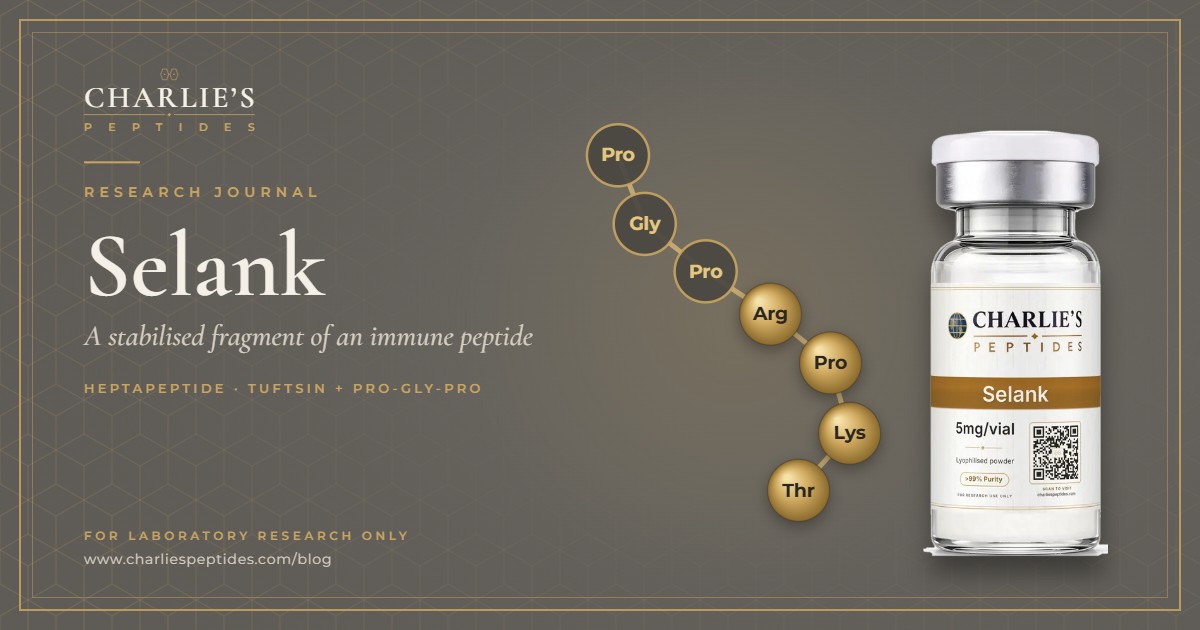
Selank is a synthetic heptapeptide, a chain of seven amino acids:
Thr-Lys-Pro-Arg-Pro-Gly-Pro
The first four, Thr-Lys-Pro-Arg, are tuftsin, a natural peptide that is cut from the heavy chain of immunoglobulin G, the most common type of antibody in blood. Tuftsin has been studied since the 1970s for its effects on immune cells, but like most very short peptides it is broken down quickly by enzymes. Selank adds Pro-Gly-Pro to the end. Proline-rich sequences tend to resist many of those enzymes, so the longer peptide survives for longer.
Selank was developed at the Institute of Molecular Genetics of the Russian Academy of Sciences, together with the Zakusov Institute of Pharmacology (Volkova et al., 2016).
What the research has looked at
Enzymes that break down other peptides
One early line of work asked whether Selank affects the enzymes that break down enkephalins, the body’s own small opioid peptides. In human serum, both Selank and Semax inhibited enkephalin-degrading enzymes (Kost et al., 2001). A 2019 review from the institute puts this interaction with the enkephalin system at the centre of its proposed model for how Selank works (Koroleva and Myasoedov, 2019).
Gene activity in the brain
The most cited English-language study is a 2016 paper in Frontiers in Pharmacology. Rats were given Selank, GABA (the brain’s main inhibitory messenger) or water once, through the nose, and the researchers measured the activity of 84 genes involved in nerve signalling in the frontal cortex, one hour and three hours later (Volkova et al., 2016).
Both Selank and GABA changed the activity of dozens of these genes. The patterns overlapped at one hour and diverged at three hours, and Selank also changed some genes that GABA didn’t, including several dopamine receptor genes. The authors suggested that Selank might act partly by modulating the GABA system, while describing this as a hypothesis for further work.
Behaviour and immune markers in animals
Other studies from the same groups, many published in Russian, have looked at animal models of anxiety-like behaviour, at learning and memory tasks, and at immune markers such as the cytokine interleukin-6. The 2019 review gathers these into a single scheme (Koroleva and Myasoedov, 2019).
What to bear in mind
- One research community. Nearly all of the work comes from the institutes that developed Selank and their collaborators, and much of it is in Russian-language journals that are hard to access and assess from outside.
- Small, specific experiments. The 2016 gene study measured messenger RNA only, after a single administration and at two time points, with tissue pooled from each group. That design can show that something changed, but not what the change means for how the brain works.
- The mechanism is a proposal. Enkephalin-degrading enzymes, GABA signalling and immune cytokines have all been suggested. None has been shown to be the main route.
For researchers
We supply Selank in the International shop, alongside its sister peptide Semax. The Selank page has sizes, prices and stock.
Sources
- Volkova A, Shadrina M, Kolomin T, et al. Selank administration affects the expression of some genes involved in GABAergic neurotransmission. Frontiers in Pharmacology. 2016;7:31. doi:10.3389/fphar.2016.00031
- Kost NV, et al. Semax and Selank inhibit the enkephalin-degrading enzymes from human serum. Bioorganicheskaia Khimiia. 2001;27(3). PubMed
- Koroleva SV, Myasoedov NF. Physiological effects of Selank and its fragments. Biology Bulletin. 2019;46(4):407–414. doi:10.1134/S1062359019040071