GHK-Cu is unusual among research peptides because it isn’t a lab invention. It is a small molecule that occurs naturally in human blood, saliva and urine, and it has been studied for half a century. It also turns up on the ingredients list of a lot of skin creams, as “copper tripeptide-1”. Here is what the research has and hasn’t established.
What it is
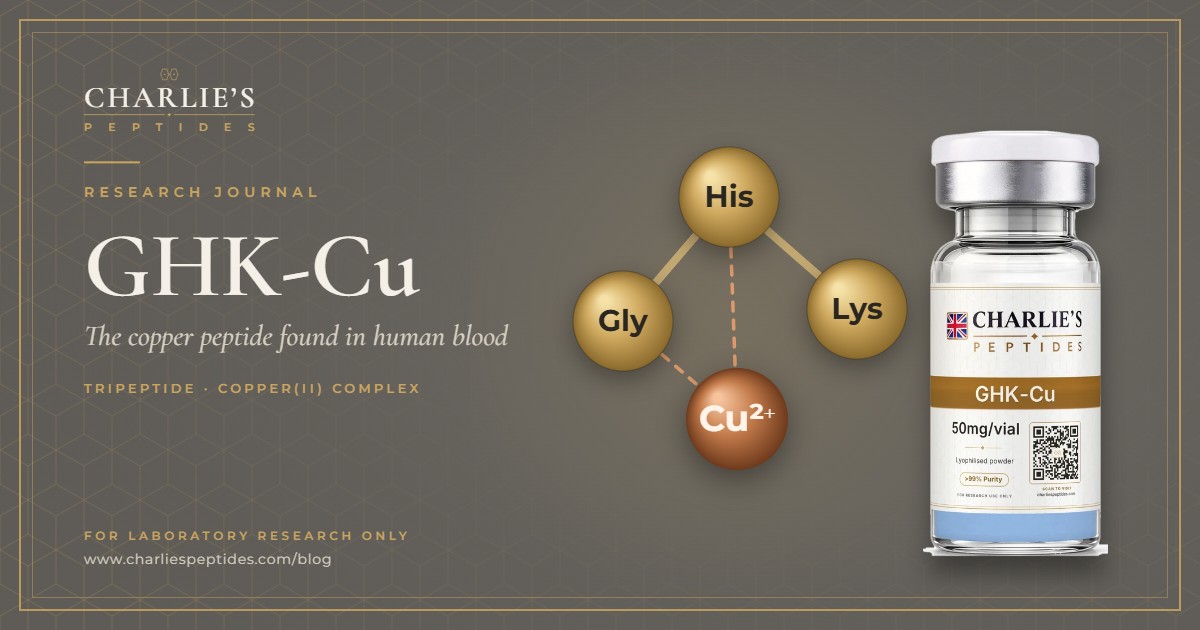
GHK is a tripeptide, a chain of just three amino acids: glycine, histidine and lysine (Gly-His-Lys). On its own it is colourless. It binds a copper(II) ion very tightly, and the copper complex, GHK-Cu, is the deep blue form usually studied and supplied.
The copper sits in a pocket formed by three nitrogen atoms: one from the histidine ring, one from the amino group of glycine, and one from the peptide bond that joins them. In the solid state, oxygen atoms from neighbouring molecules complete the arrangement.
Where it came from
The peptide was found in 1973 by Loren Pickart, who was studying differences between blood plasma from younger and older people, and their effects on liver cells grown in culture. The factor he isolated turned out to be GHK. Later work showed that it binds copper, and suggested that it helps carry copper into cells (Pickart et al., 1980).
Its level in plasma falls with age. Figures quoted in the literature are about 200 nanograms per millilitre at age 20 and about 80 at age 60 (Pickart and Margolina, 2018).
What the research has looked at
Connective tissue in cell culture
One of the best-known early results came from a French group in 1988. In cultures of fibroblasts, the cells that make the skin’s structural proteins, GHK-Cu increased the amount of collagen the cells produced (Maquart et al., 1988). Later studies extended this to other structural molecules, such as elastin and glycosaminoglycans, and to the enzymes that break down and rebuild the tissue around cells.
Wound models in animals
GHK-Cu has been tested in wound models in rabbits, rats, mice, pigs and dogs, including models of slow-healing wounds in diabetic and ischaemic rats. These studies are summarised in two reviews by Pickart and colleagues (2015, 2018).
Gene expression data
The most recent strand of work used public gene expression databases, such as the Broad Institute’s Connectivity Map, which records how more than a thousand compounds change gene activity in human cell lines. In those data, GHK is associated with changes in the activity of a large number of genes, including 47 DNA repair genes that were up by at least half and 5 that were down (Pickart et al., 2015). These are computational associations from cell-line data. They describe patterns, not effects in a living organism.
Cosmetic studies
Because it is cheap, stable and water-soluble, GHK-Cu has been widely used in cosmetic formulations, and there are a number of small studies of creams containing it.
Caveats worth knowing
- Much of the summary literature comes from one source. The main review articles are written by the peptide’s discoverer and colleagues at a skincare research company. That doesn’t make the work wrong, but independent replication matters more than usual.
- Several cosmetic studies are not peer reviewed. Some of the human skin studies cited in reviews were presented at conferences rather than published in peer-reviewed journals.
- Gene data are not outcomes. Database associations are useful for generating hypotheses, and they are frequently overstated in popular write-ups.
- The mechanism isn’t settled. Researchers still debate how much of the activity comes from the peptide itself, how much from delivering copper, and how much from the copper being taken away from elsewhere.
Where it stands
GHK-Cu is not a licensed medicine. It is permitted as a cosmetic ingredient under the name copper tripeptide-1. In the US, the FDA’s pharmacy compounding advisory committee is due to consider it at a meeting before the end of February 2027.
For researchers
We supply GHK-Cu in both shops, along with its close relative AHK-Cu (alanine in place of glycine) and two blends that include it. The GHK-Cu 100mg certificate is published in full. The GHK-Cu page has sizes, prices and stock.
Sources
- Pickart L, et al. Growth-modulating plasma tripeptide may function by facilitating copper uptake into cells. Nature. 1980;288:715–717. doi:10.1038/288715a0
- Maquart FX, et al. Stimulation of collagen synthesis in fibroblast cultures by the tripeptide-copper complex glycyl-L-histidyl-L-lysine-Cu2+. FEBS Letters. 1988;238(2):343–346. PubMed
- Pickart L, Vasquez-Soltero JM, Margolina A. GHK peptide as a natural modulator of multiple cellular pathways in skin regeneration. BioMed Research International. 2015;2015:648108. PubMed
- Pickart L, Margolina A. Regenerative and protective actions of the GHK-Cu peptide in the light of the new gene data. International Journal of Molecular Sciences. 2018;19(7):1987. PubMed
- FDA Pharmacy Compounding Advisory Committee schedule, as reported after the July 2026 meeting: summary