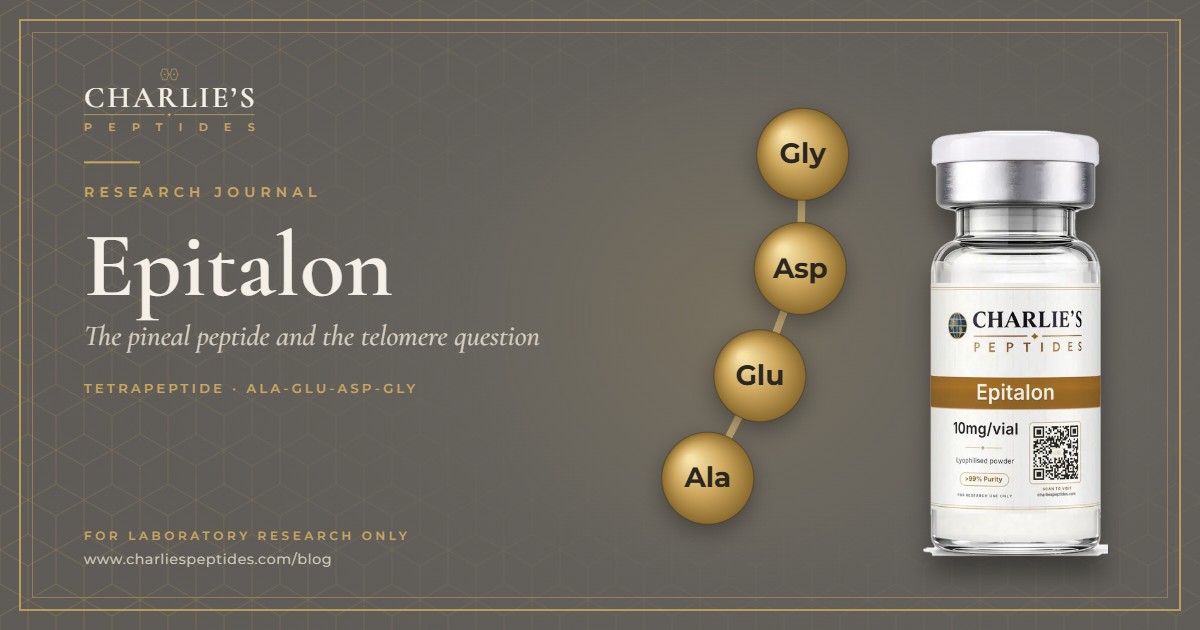
Epitalon (also spelled Epithalon, and known by its sequence AEDG) has a large reputation for a very small molecule. Most of that reputation rests on telomere experiments in cultured cells and on lifespan studies in rodents, almost all from one research institute. Here is what those studies did and what they can and can’t tell you.
What it is
Epitalon is a synthetic tetrapeptide, a chain of four amino acids:
Ala-Glu-Asp-Gly (alanine, glutamic acid, aspartic acid, glycine)
It was designed from the amino acid make-up of epithalamin, an extract of cattle pineal gland that Soviet and then Russian researchers had been studying since the 1970s. The work was led by Vladimir Khavinson and Vladimir Anisimov at the St Petersburg Institute of Bioregulation and Gerontology, and the synthetic peptide was patented in Russia in 2001 (Araj et al., 2025).
What the research has looked at
Telomeres in cultured cells
Telomeres are the protective caps on the ends of chromosomes. They shorten each time a typical cell divides, and the enzyme telomerase can rebuild them. Most adult human cells make very little telomerase.
In 2003, Khavinson’s group reported that adding Epitalon to cultures of human fibroblasts switched on telomerase activity and lengthened telomeres (Khavinson et al., 2003). A follow-up the next year reported that treated cells carried on dividing beyond the point where untreated cells stopped, a limit known as the Hayflick limit.
The most useful recent addition comes from outside that group. In 2025, researchers at Brunel University London tested Epitalon on normal human epithelial cells and fibroblasts, and on two breast cancer cell lines (Al-dulaimi et al., 2025). In the normal cells, telomeres lengthened alongside higher expression of the telomerase gene. In the cancer cells, telomeres also lengthened, but through a different, telomerase-independent route called ALT (alternative lengthening of telomeres). That second finding is a reminder that telomere lengthening isn’t a simple good-news measure.
Lifespan in animals
The St Petersburg group also ran long-term studies in mice and rats. In one, female mice were given Epitalon regularly, and the researchers tracked markers of ageing, lifespan and the rate of tumours that develop spontaneously in that strain (Anisimov et al., 2003). They reported changes in several of these measures in the treated animals.
Gene expression
More recent papers from the same school propose that short peptides like AEDG can enter cells and interact with DNA and histone proteins directly, influencing which genes are switched on. One such study looked at gene expression and protein production in stem cells being turned into nerve cells (Khavinson et al., 2020). This proposed mechanism is not widely tested outside that group.
What is still missing
- Independent replication. Until very recently almost all of the work came from one institute, and much of it was first published in Russian-language journals. The 2025 Brunel study is one of the few independent tests, and it was in cells.
- Safety data. A 2025 review by researchers in Poland concluded that studies of short and long-term toxicity, genotoxicity and cancer potential are still needed (Araj et al., 2025).
- Basic chemistry. The same review notes that physical and structural studies of the peptide are very limited, and the mechanism remains unclear.
- Careful human trials. The human studies that exist are small, and many were run with the pineal extract epithalamin rather than Epitalon itself.
Where it stands
Epitalon isn’t a licensed medicine in the UK, the EU or the US. In July 2026 it was one of the peptides an FDA advisory committee recommended for inclusion on the list of substances US pharmacies may compound. That recommendation isn’t an approval, and the FDA hasn’t yet acted on it.
For researchers
We supply Epitalon in the International shop. The Epitalon page has sizes, prices and stock.
Sources
- Khavinson VK, Bondarev IE, Butyugov AA. Epithalon peptide induces telomerase activity and telomere elongation in human somatic cells. Bulletin of Experimental Biology and Medicine. 2003;135(6):590–592. PubMed search
- Khavinson VK, Bondarev IE, Butyugov AA, Smirnova TD. Peptide promotes overcoming of the division limit in human somatic cell. Bulletin of Experimental Biology and Medicine. 2004;137(5):503–506. PubMed search
- Anisimov VN, et al. Effect of Epitalon on biomarkers of aging, life span and spontaneous tumor incidence in female Swiss-derived SHR mice. Biogerontology. 2003;4(4):193–202. PubMed
- Khavinson V, et al. AEDG peptide (Epitalon) stimulates gene expression and protein synthesis during neurogenesis: possible epigenetic mechanism. Molecules. 2020;25(3):609. PubMed
- Araj SK, Brzezik J, Mądra-Gackowska K, Szeleszczuk Ł. Overview of Epitalon: highly bioactive pineal tetrapeptide with promising properties. International Journal of Molecular Sciences. 2025;26(6):2691. PubMed
- Al-dulaimi S, Thomas R, Matta S, Roberts T. Epitalon increases telomere length in human cell lines through telomerase upregulation or ALT activity. Biogerontology. 2025;26(5):178. doi:10.1007/s10522-025-10315-x
- FDA Pharmacy Compounding Advisory Committee, 23–24 July 2026: summary of the votes