BPC-157 is one of the most talked-about compounds in any research catalogue, and one of the most over-described. A lot of what is said about it online goes well beyond what the published studies show. This is a plain summary of where it came from, what researchers have tested, and where the gaps are.
What it is
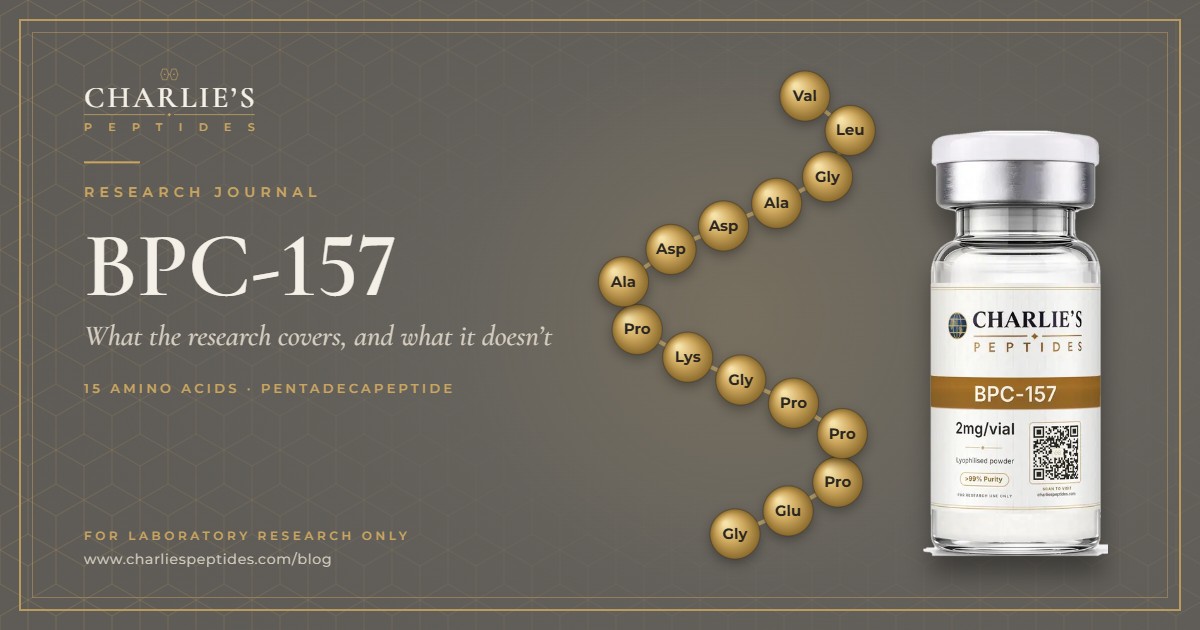
BPC-157 is a synthetic peptide made of 15 amino acids:
Gly-Glu-Pro-Pro-Pro-Gly-Lys-Pro-Ala-Asp-Asp-Ala-Gly-Leu-Val
The letters BPC stand for “body protection compound”. The sequence is a fragment of a larger protein that researchers reported finding in human gastric juice. Much of the early interest came from reports that it stays intact in stomach acid for a long time, which is unusual for a peptide. It was first described in the early 1990s by a group at the University of Zagreb in Croatia, led by Predrag Sikirić, and that group has produced a large share of the literature since.
What the research has looked at
The gut lining
The earliest work was on the stomach and intestine, in rodent models of lesions caused by alcohol, anti-inflammatory drugs and other irritants. That is where the phrase “gastric pentadecapeptide” in many paper titles comes from: pentadecapeptide simply means a peptide of fifteen amino acids.
Tendon, ligament and muscle
The area that gets most attention now is soft tissue. In a 2003 study, rats with a surgically cut Achilles tendon were given BPC-157 or saline, and the researchers compared tendon strength, stiffness, walking function and the appearance of the tissue over 14 days (Staresinic et al., 2003). They reported better results in the treated animals, and the same paper looked at tendon cells grown in a dish.
Later cell studies from a group in Taiwan tried to work out why. Using rat tendon fibroblasts, they reported more outgrowth of cells from tendon explants, better survival under oxidative stress and faster migration (Chang et al., 2011). A follow-up found more growth hormone receptors on the surface of the same cells (Chang et al., 2014).
Blood vessel growth
A recurring theme is angiogenesis, the growth of new blood vessels. A 2017 paper combined cell experiments with animal models and linked BPC-157’s effects to activation of VEGFR2, one of the main receptors that controls vessel growth (Hsieh et al., 2017). Many papers from the Zagreb group also describe interactions with the nitric oxide system.
What the research doesn’t show yet
This is the part most summaries leave out.
- Almost all of it is in animals or cells. A 2025 systematic review in orthopaedic sports medicine screened 544 records and kept 36 studies. Thirty-five were preclinical. The only human study was a retrospective look back at 12 patients, with no control group (Vasireddi et al., 2025).
- Safety in people is unknown. The same review says human safety wasn’t assessed in any of the studies it found, and that the animal safety data only covered periods of up to six weeks.
- Few independent groups. An earlier review noted that only a handful of research groups had studied BPC-157 in depth over two decades, mostly in small rodents, and that its efficacy “is yet to be confirmed in humans” (Gwyer et al., 2019).
- The mechanism is unsettled. Papers point to blood vessel growth, nitric oxide signalling, growth factor receptors and cell migration, but there is no agreed account of how it works, or which of these effects matters most.
Where it stands
BPC-157 is not a licensed medicine in the UK, the EU or the US. The World Anti-Doping Agency has listed it as a prohibited substance since 2022. In July 2026 an FDA advisory committee voted 8 to 6 to recommend that US pharmacies be allowed to compound it (summary of the meeting). That vote is advice to the FDA rather than an approval, and it doesn’t settle any of the questions above.
For researchers
We supply BPC-157 for laboratory research, on its own and blended with TB-500. Batches are tested by an independent laboratory, and the certificate for our BPC-157 10mg is published in full. The BPC-157 page has sizes, prices and stock.
Sources
- Staresinic M, et al. Gastric pentadecapeptide BPC 157 accelerates healing of transected rat Achilles tendon and in vitro stimulates tendocytes growth. Journal of Orthopaedic Research. 2003;21(6):976–983. PubMed
- Chang CH, et al. The promoting effect of pentadecapeptide BPC 157 on tendon healing involves tendon outgrowth, cell survival, and cell migration. Journal of Applied Physiology. 2011;110(3):774–780. PubMed
- Chang CH, et al. Pentadecapeptide BPC 157 enhances the growth hormone receptor expression in tendon fibroblasts. Molecules. 2014;19(11):19066–19077. Full text
- Hsieh MJ, et al. Therapeutic potential of pro-angiogenic BPC157 is associated with VEGFR2 activation and up-regulation. Journal of Molecular Medicine. 2017;95(3):323–333. PubMed
- Gwyer D, Wragg NM, Wilson SL. Gastric pentadecapeptide body protection compound BPC 157 and its role in accelerating musculoskeletal soft tissue healing. Cell and Tissue Research. 2019;377(2):153–159. PubMed
- Vasireddi N, et al. Emerging use of BPC-157 in orthopaedic sports medicine: a systematic review. HSS Journal. 2025;21(4):485–495. PubMed
- FDA Pharmacy Compounding Advisory Committee, 23–24 July 2026: summary of the votes